
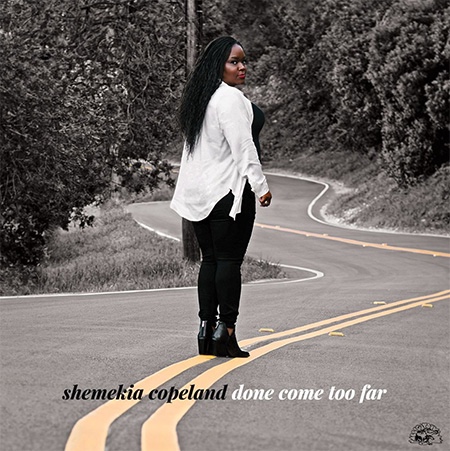
It’s a wonderful feeling to discover new artists that you go on to become a huge fan of, but it’s even more wonderful to be a little bit late to the party when becoming a fan of already well established artists. This is how I felt when listening to Shemekia Copeland for the first time. Where have I been living? Under that rock that so many people talk about?
A true gem of a singer who is the real deal – much like most of the old soul Blues music artists, Shemekia is an artist who can make you feel the words she is singing. For Shemekia, these are more than just words, they are her experiences, her beliefs and you won’t hear her singing about anything she isn’t passionate about.
In the past, Copeland has released music that touches on Black history – 2018 marked the release of America’s Child, Copeland’s first in a trilogy of albums concerning the state of the world, sung from her perspective as a young, Black woman and new mother. With the US trying to erase history from the history books, this is obviously a very important subject, as it should be, for everyone. We briefly spoke about how without accurate history, my son wouldn’t have the fascination on Katherine Johnson that he has and how important her accomplishments at Nasa were, how he was shocked at how both women in general and Black people were treated back then.
There are still battles to win of course and that’s where her part of her latest album Blame It On Eve comes into play. The title track focuses on women’s rights. It’s a cleverly written track that touches on society’s view of the original sin and how that led to years of unfair treatment towards women. The entire album plays like a finely tuned orchestra of beautiful tracks from start to finish. Tracks about motherhood, about a sad love story, a song about the legendary Tee Tot Payne and his important place in music history including his massive influence on country music, and of course a song of her father’s Johnny Copeland.
Shemekia has recently been nominated for Blues Artist of The Year at the Jazz FM awards. This is the first of what we hope to be many nominations for her at the Jazz FM awards. Richly deserved, we will definitely be rooting for her.
We caught up with Shemekia to discuss this nomination, a first for her at the Jazz FM awards. We also spoke about her latest album and more.
Let’s jump straight into the Jazz FM awards. So Congratulations on your nomination for Blues Act of The Year. That must be quite exciting?
It is exciting. I’m surprised because I don’t get to come over there (UK) as much as I would like, but I’m happy to be recognized.
Have you ever been nominated for Jazz FM Awards before?
No, this is my first time.
Oh, that’s really exciting. So are you coming over for it?
Well, I hope that I can.
Was the nomination just a surprise, or is it something that you campaign for? Did you have any inkling that this was going to happen?
Nope, I had no idea about it. I found out that I was nominated, and I was just really excited.
Have you had a look into who else has been nominated?
Yea, Christone “Kingfish” Ingram. I just love him. I’ve known him since he was a little, you know, a little boy. So I’m so excited for him. I’m always excited for him.
What I love about awards around genres, because I love country music, so country music, jazz music and blues, what I really love about when it’s a genre based awards is that it’s a community, so for nominees, it’s a mix between everybody wants to win, but they also don’t want to because they want their friends to win.
Exactly, and that’s, that’s how you feel. And you’re very happy for your friends too, you know?
It’s all really genuine. I have been listening to ‘Blame It On Eve’ a lot recently and I absolutely love it. I think it’s fantastic. I wanted to know if you could tell me a little bit about it and what we’re blaming her for?
Actually we’re blaming her for nothing. It’s more of a song about women’s rights. You know what I’m saying? That’s what I was going for with that song. Just trying to do it in a clever in a clever way.
It’s an important point at the moment as well, isn’t it? especially with reproductive rights, our rights to our own body and everything going on in the US.
It’s quite an issue. Absolutely, yeah,
I wanted to ask about working with Will Kimbrough.
Oh, he’s so talented. This is my fourth project that I’ve done with him and me, with John Hahn, who’s a writer and also my manager. I mean, we are the “Dream Team”. We really are. Yeah, we are a dream team. And it’s, it’s amazing what we have managed to accomplish, and we all care about the same things. You know, women’s rights, social injustice, you name it, you know we care about it, and so we also care about history and historical things. So it’s why we work very well together, yeah.
In your previous albums, you’ve written about black history and other important issues, so your albums have such deep meaning. I’ve read somewhere, that most of your songs are written about the conversations that you have so not necessarily sitting down in a writers session and deciding what to write about?
I mean, I’ve known Hahn since I was eight years old. So he’s really been, you know, a father to me. You know, my father died when I was 18, and ever since then, you know, he stepped in, in a big way, in every way, you know what I mean, in my life. So we talk every day of my life, and, you know, and we talk about everything from family to politics to this, to that to, you know? So these things just come up, you know. And before you know it, there’s a song. It’s amazing.

I want to talk about the book ends of an album. I wanted to know, do you take a lot of time to think about how to start the album and how to close it?
Oh, yeah, we definitely do. It’s all about presentation, right? So you want to make sure that people are hearing it the way that you want them to hear it, you know? And just like when you’re doing a live performance, in a performance, there’s this sort of, it’s like a roller coaster a bit, right? You know that you got your ups, got your downs, you know, it’s in your all in between. We want the album to be heard the same way. Even though people don’t really listen to music like that anymore. I still do,
I do too!
I still love to listen to a full album, you know? Man, I love that, when I was a kid, you put an album on and you just listened to the whole thing. It was an experience, right?
Yeah, you did and it was!
We are still very much an album crowd here in the UK. We’re album fans. A lot of the time when I interview American artists, they say they love playing over here because they can play tracks, deeper cuts. But in America, a lot of crowds want the hits. You can play a whole show of just deeper cuts and even new music in the UK, we’re here for it. We love it!
I love that!
I wanted to know if any of the songs that you’ve written or recorded, have sounded completely different from when they were first written to full production, to the point where you’re like, wow, I didn’t know that song could sound like that.
There’s always a bit of an evolution. You know, when you get into the studio, you go through moments like that. But we do have a very pretty good idea of what it’s going to sound like before that, because you know, we’re making Blues records, and we don’t have time to just, you know, spend hours and hours at a studio. We got to be prepared before we get there, you know. Yes, you have a very good idea as to what it’s going to sound like. But once you finally hear it, it’s pretty awesome.
Does a live element go to play when creating music? Do you consider how it’s going to translate in a live setting?
Yeah, you know and some things work on records that don’t really translate well stage. That happens too, but that’s okay.
I want to talk about ‘Tough Mother’, because I’m loving all the songs that are focused on motherhood, because as a mum myself, there is never going to be enough songs about motherhood.
The thing about ‘Tough Mother’ is, is that, you know it’s about motherhood, but it’s also about just me, right, um, and my life and in my struggles and what I’ve had to go through, you know what I mean? and why I’m a tough mother, you know? And then motherhood just brings it all .So I went through all of this, and now here I am. I went through all of this to be this, right? So I’m a tough mother all the way around.
Another one I really love, of course, is ‘Wine O’Clock’. What is your go to wine of choice?
Well, these days, I don’t, it’s so funny because as soon as I put this record out, I quit drinking alcohol. Not that I drank that much anyway, but I just hormonally. I have to have less caffeine, and you know what I mean, all stuff like that. So I stopped drinking. But before, I loved champagne, and I loved a good Cabernet. And when I came to the UK, I always had Sauvignon Blanc, that would be what I ordered at the pub.
Let’s talk Tee Tot Payne, because I cover country music as well. You say that country and blues are first cousins, which I agree with. I love crossover genres. So please tell me a bit about the song.
On all of my albums, we do something historical. They want to take history out of the history books here, and that drives me crazy. And so on each record of mine, you know, I love to do a song that teaches, that teaches something. What an amazing, interesting character, you know? He had such a huge part in the influence in country music. And not a lot of people knew about him. We wanted to talk about him.
I read that he basically was the reason, Tee Tot Payne that is, that he pretty much made Hank Williams who he was?
Yeah, exactly, he did! Well, I grew up listening to Hank Williams because my dad was a big fan.
Do you have any other favourite country music artists?
I was obsessed with Patsy Cline. I’m a big fan of old country. Patsy to me. Patsy Cline was just a blue singer, you know, you know what I mean?
I do! And you recorded this album in Nashville?
Yes, always! My last few albums have all been in Nashville, probably the last seven or whatever. The musicians are there, my producer, Will Kimbrough, lives there. There’s so many studios there. It’s crazy. It’s so many studios, so it just it’s easier to record there.
Tell me about your dad. You spoke about him early on. What’s the influence that he had on you, not just musically, but personally as well, and your mum as well?
Well, yeah, I mean, I was so fortunate to grow up with the most amazing parents. I just wouldn’t be who I am today if I wasn’t raised by those two people, you know what I mean? Just both strong, amazing, people. My father was able to do what he loved to do, because my mom, you know, was who she was, and so grounded and supportive, and then she turned out to be just that same way for me, she was my absolute biggest fan, and my father was a very hard worker. He always taught me to be original because why be like other people, right? I want to be 100% Shemekia Copeland, you know what I’m saying?
Of course, we all have influences. But no, I want to be original. And he always said, “never read the press”. I love that one. He always used to say, “if you read the press and it’s good, you become cocky and arrogant, and if you read it and it’s bad, you become bitter and angry”. So I always like to hold on to that one. You know what I mean? Not that I don’t read some of it, but you know what I mean, I’ve met some of those people, so I try not to be that, you know?
I think that’s a good saying for life in general. Whether you’re somebody in the public eye or not, just don’t listen to the negativity either way and take the positivity in your stride. Don’t let the compliments make you arrogant.
Yeah, of course, exactly.
What venues have you played in the UK, and are there any venues that you’d like to play that you haven’t played yet?
The 100 club? Probably but there’s jazz club there that I’d love to play.
Ronnie Scotts?.
Yes! I’d love to play there for a week. That would be wonderful.
You should do it. You should do it.
That would be awesome. Yeah, but my ultimate goal Royal Albert Hall.
How do you feel blues has changed over the years?
It’s changed a lot. I mean, that’s a tough one for me, because I grew up, I grew up with with artists like my father and Lonnie Brooks and Luther Allison and, you know, Son Seals and Otis rush. I just saw Buddy Guy, you know. There’s just like this raw, this raw talent and it just comes from a place of where they grew up, how they had to grow up, what they had to do to get to where they were. I mean, I just think it all influenced their sound. Do you know what I mean? Just like I said, there’s just a rawness, a roughness of it, an original miss that just comes from these particular artists. And, you know, I feel like nowadays, everybody just wants to sound like everybody else. You know what I mean? and everybody’s is just looking to put out hits and stuff like that. It’s just different. It’s just different. You know, I always say that if I don’t get up here and sing this song right now, I won’t be able to survive today. You know, because this is because this is healing me in some sort of way. This is, this is what I need to make it through. You know, somehow that’s changed, you know, for me these days.
I mean, that’s the thing about the blues music in particular, especially when you see it live. When you see it live, you know the authenticity behind it. You know someone can feel it mostly just in the facial expressions. And let’s just say jazz, the way people play it – I remember watching Courtney Pine playing music, and I was just like, this, the way he played it, the authenticity behind it, the passion, it was like nothing else.
..and it’s also about how they make you feel. You know what I’m saying? So I feel like it’s just like, you have some players, they get up there and they play 1000 notes, but you felt nothing from it. You know, technically, they played beautifully, and it was great, but you felt nothing. But then there’s a guy who sings, who plays three notes, or somebody who sings three notes, and those notes, yeah, make you feel a certain type of way, you know. And that right there is, that’s what I mean. It’s hard to explain.
I get it. You just reminded me of something years and years and years ago on the UK X Factor, there was this really, really talented male musician, singer, and Simon Cowell told him off for closing his eyes when he sang. I was like, but that’s when I believe him. He told him “you gotta keep your eyes open and you gotta pay attention to the audience.” I’m like, but when he closes his eyes, that’s when I believe him, because I know he’s feeling it. They made him stop doing that. The same with making artists stop putting out stuff that they really, really believe in. And when I hear of an artist say that they have really pushed for that song, i’m really glad. When you said everyone kind of sounds like everyone else, that resonates because right now, especially in pop music, there’s so many artists who are trying to be Taylor Swift.
Yeah, yeah.
Thank you so much for talking today. It’s been really, really lovely. Good luck with the award. I really, really hope that you win.
Thank you.
Categories: Bluesville, Interviews, Introducing, Jazz Town, Latest, Soul Train






 Building Our Own Nashville